

India’s Trusted Digital Infrastructure for Invoice Verification & Financing
InvoiceHub is India’s unified platform for verified invoices, enabling real-time invoice validation, GST e-Invoice authentication, audit workflows and fraud prevention for financial institutions


What is invoicehub?
InvoiceHub is India’s first and only universal repository for verified and funded invoices, built by IBDIC to create a safer, more transparent, and more efficient invoice financing ecosystem. It serves as a trusted digital infrastructure layer that enables lenders, corporates, marketplaces, and regulators to verify invoice authenticity, prevent duplicate financing, and improve access to working capital.
At its core, InvoiceHub acts as a single source of truth for invoice financing. Every invoice is assigned a unique digital fingerprint, allowing participating institutions to detect duplicate funding attempts, identify fraudulent invoices, and maintain a comprehensive audit trail. This helps reduce risk for lenders while improving confidence and liquidity across the supply chain finance ecosystem.
Digital fingerprinting to verify invoices and prevent fraud or duplicate financing.
It uses proprietary algorithms and advanced fingerprinting technology to check and verify invoices in real-time.
Why InvoiceHub?

What INVOICEHUB enables for you?
- Enables faster financing through verified invoice data.
- Builds lender trust with standardized validation.
- Reduces disputes, rejections, and back-and-forth with financiers.
- Improves cash flow visibility across supply chain operations.

What INVOICEHUB enables for you?
- Helps improve access to finance through verified invoices.
- Reduces financing friction with trusted invoice records.
- Supports quicker approvals by improving invoice credibility.
- Enables smoother cash flow for day-to-day business continuity.

What INVOICEHUB enables for you?
- Prevents double financing by detecting duplicate or funded invoices.
- Improves authenticity checks through seamless invoice verification.
- Creates audit trails for stronger compliance and transparency.
- Provides early risk signals for proactive monitoring.
- Reduces concentration and cyclical risks in lending.
- Ensures secure, reliable, Made-in-India infrastructure.

What INVOICEHUB enables for you?
- Enables ecosystem-wide visibility through a centralized invoice repository.
- Improves fraud detection across lenders and financing programs.
- Standardizes invoice verification across participating institutions.
- Strengthens audits with digital trails for reviews and inspections.
- Reduces systemic risk through better transparency and control.
The Old Way vs The InvoiceHub Way
|
|


Traditional Invoice Financing |


IBDIC InvoiceHub |

Invoice Visibility |

No visibility into invoice funding across lenders |

Real-time universal view of invoice status across entire ecosystem |

Duplicate Financing |
Duplicate financing goes undetected until default |
Duplicate financing prevented before it happens |

Invoice Verification |
Manual verification of 5–10% of invoices quarterly |
100% real-time automated verification of every invoice |

Operational Efficiency |
High operational costs for third-party audits |
Zero manual verification effort, fully automated |

Lender Confidence |
Lenders limit exposure due to fraud risk |
Lenders confidently expand invoice financing programs |
Secure Invoice Financing with InvoiceHub
Or mission is to make the invoice eco-system in India safer and better to enable capital efficiency, SME financial inclusion and higher returns.
Thank You!
We've received your request. Our team will get in touch with you shortly.
Frequently Asked Questions
What is InvoiceHub?

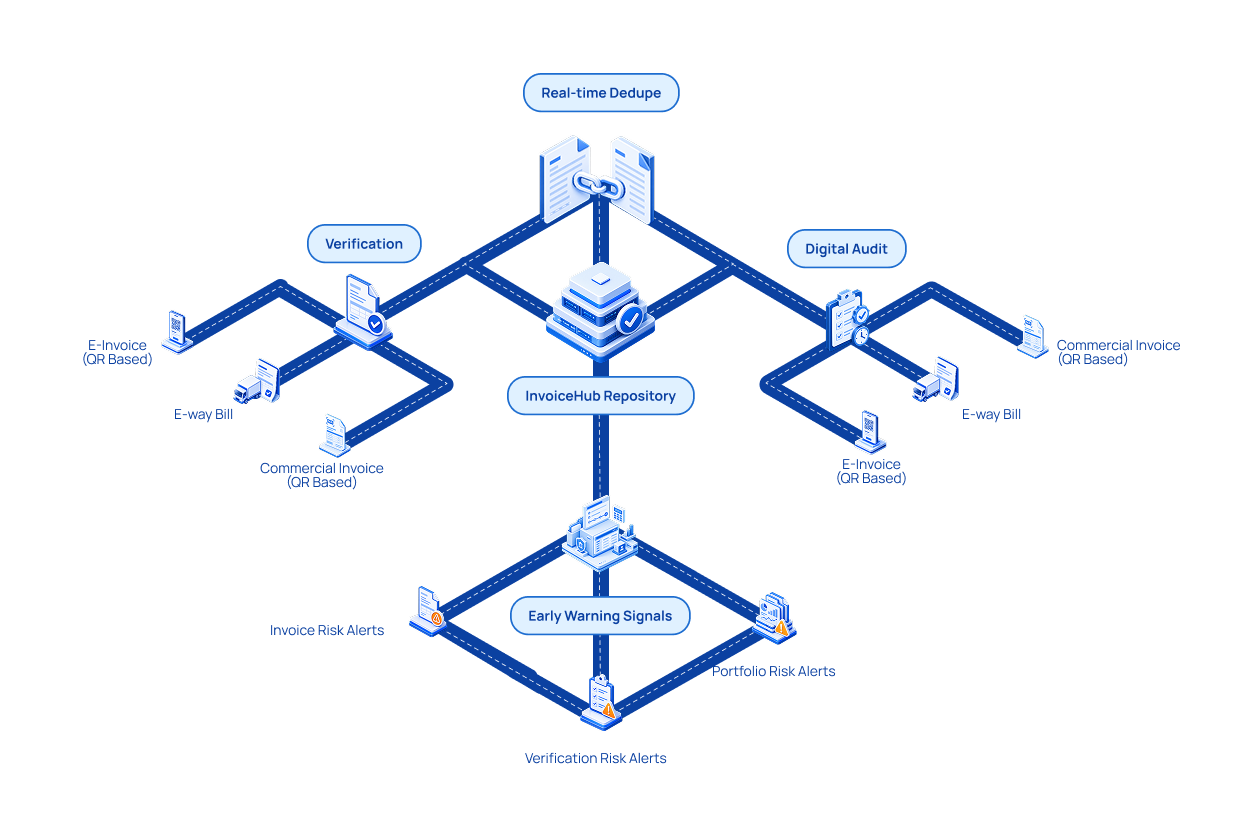
InvoiceHub serves as a universal repository of verified and funded invoices in India. It is designed to make the invoice ecosystem safer, more transparent and efficient for supply chain finance. Operating across a DPI (Digital Public Infrastructure) layer and a solution layer, InvoiceHub provides capabilities such as invoice verification, deduplication, digital audit and early warning risk signals. By creating a single source of truth for invoice financing, InvoiceHub helps lenders reduce fraud risk, enables faster access to capital for corporates and supports better monitoring and oversight for regulators.
How does InvoiceHub integrate with existing systems?
InvoiceHub can be accessed through multiple integration options to suit different operational needs. It supports API-led integration with lender systems (such as LOS/LMS) for real-time processing, SFTP-based integration for batch file transfers and a web-based InvoiceHub portal for manual operations. This flexible approach ensures seamless adoption with minimal disruption to existing workflows.
What are the key advantages of InvoiceHub for financial institutions?
InvoiceHub provides financial institutions with a robust framework to enhance risk management, improve operational efficiency, and ensure compliance. Key advantages include:
- Prevention of double financing: Ability to detect duplicate or already funded invoices across the entire ecosystem.
- Enhanced invoice authenticity checks: More seamless and reliable verification compared to traditional methods.
- Comprehensive digital audit: End-to-end audit trails for invoices, ensuring higher compliance and transparency.
- Early warning signals: Access to risk indicators that enable proactive portfolio monitoring beyond traditional underwriting data.
- Risk reduction: Helps mitigate cyclical and concentration risks, especially in anchor-led corporate lending programs.
- High reliability and data security: Built as a consortium-driven, “Made-in-India” platform, ensuring trust, data safety, and long-term sustainability.
What are the key advantages of InvoiceHub for regulators?
InvoiceHub enhances transparency, standardization, and oversight across the invoice financing ecosystem. Key advantages include:
- Ecosystem-wide visibility: Access to a centralized repository of verified and funded invoices, enabling better monitoring across lenders and programs.
- Better risk management through Improved fraud detection: Identification of duplicate financing and suspicious invoice patterns at an industry level. Reduce systemic risks and better predictability of fraudulent invoices
- Standardized verification framework: Consistent processes for invoice validation, reducing fragmentation across institutions.
- Stronger audit and compliance: Availability of digital audit trails to support regulatory reviews and inspections.
- Enhanced financial stability: Helps reduce systemic risks in supply chain finance by improving transparency and control mechanisms.
How does InvoiceHub verify the authenticity of invoices?
InvoiceHub verifies invoice authenticity through two key services:
• E-Invoice Verification: Validates invoices using GSTN-compliant QR codes to ensure the invoice is genuine and issued by the supplier.
• E-Way Bill Verification: Cross-verifies invoice details with associated E-Way Bill data to confirm the legitimacy of the transaction.
Is E-Way Bill verification a corporate consent-based journey?
Yes, E-Way Bill verification on InvoiceHub is a consent-driven process to ensure secure and compliant access to GSTN data.
The journey works as follows:
- Consent initiation: The lender obtains consent from the corporate via the ConsentHub portal and provides GSTN-level and GSP credential details.
- Invoice submission: The corporate shares invoices with the lender for discounting/financing.
- Verification request: The lender sends an invoice verification request to InvoiceHub (IBDIC).
- GSTN validation: InvoiceHub validates invoice details against GSTN E-Way Bill data.
This consent-led flow ensures secure access to data, accurate invoice validation, and compliance with regulatory requirements, while enabling lenders to make informed financing decisions.
Do lenders need to take consent again if it has already been provided by a corporate to another lender?
No. Once a corporate provides consent on the ConsentHub portal for a specific GSTN, the same consent can be leveraged by all live/onboarded lenders on InvoiceHub for invoice verification.
How does this work?
- A corporate provides one-time consent via the ConsentHub portal.
- The consent is registered at a GSTN level and made available within the InvoiceHub ecosystem.
- All authorized lenders (live members) can use this consent to perform E-Way Bill–based invoice verification.